


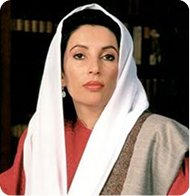
Shaheed Mohtarma Benazir Bhutto
Born June 21, 1953, in Karachi, Pakistan
Daughter of Shaheed Zulfikar Ali Bhutto (a political leader and former Prime Minister) and Nusrat Bhutto (former Member of Parliament and Deputy Prime Minister of Pakistan) Married, December 18, 1987 to Asif Ali Zardari (in business, twice elected Member of National Assembly and Senate) Ms Bhutto was sworn in as Prime Minister for the first time in 1988 at the age of 35, but was removed from office 20 months later under the order of then-president Ghulam Ishaq. In 1993 she was re-elected but was again removed in 1996 by then-president Leghari. She went into exile in Dubai in 1998. She returned to Pakistan on 18 October 2007. She was assassinated on 27 December 2007, after departing a PPP rally in Liaqat Bagh, Rawalpindi. Children: Mr. Bilawal Bhutto Zardari, Ms Bakhtawar Bhutto Zardari and Ms Aseefa Bhutto Zardari.
Education
Radcliffe College, Harvard University, B.A., 1973; Lady Margaret Hall, Oxford University, B.A., 1976; Graduate study at Oxford in Foreign Service, 1976-77.
Career
Political activist with the Pakistan Peoples Party (PPP), Pakistan, 1977-84; repeatedly imprisoned and kept under house arrest by the Pakistani government; political exile in London, England, 1984-86; returned to Pakistan in April, 1986; Pakistan Peoples Party, Karachi, Pakistan co-chair, beginning in 1986; After elections held November 1988, invited to form the government, became Prime Minister in 1988 but her government was illegally dismissed in August 1990. She again came to power after her party won a majority in elections held in October 1993. Her government was once again dismissed illegally in November 1996.
Struggle For Democracy
Mohtarma Benazir Bhutto continued the legacy of her father as she endeavored wholeheartedly to make Pakistan a land of her father’s dreams. A Pakistan, for which Shaheed Zulfikar Ali Bhutto, her father had laid down his life. Benazir felt and saw the sorrows of her nation and struggled to ensure democracy and justice, providing equality to all, strengthening the country so that it worked on laws, and not the principle of “Might Is Right.”
Mohtarma Benazir Bhutto fought and won general elections to become the first woman elected democratically to lead a Muslim country. The detractors of democracy weren’t happy with her election. But she was just as unique as her name. She stood firm against all opposition and continued her journey on the path to democracy.
For the generation of Pakistanis born after General Zia-ul-Haq’s military coup, Benazir was the epitome of democracy and diplomacy. Her political objective was evident in her slogan of ‘Ilm, Roshni, Sab ko Kaam,’ coined for the 2007 Manifesto. She wanted to establish a democratic and a peaceful Pakistan in which people can live in harmony with equal opportunities to all. She believed that Pakistan could play an essential role in bringing the world on one platform and bring about global peace.
It was during her governments, in 1988 and 1993 that for the first time in the history of Pakistan, the press and media were given due rights by the freedom of speech, and political opponents received due coverage. Political prisoners were released, and student unions were restored to ensure the full effect of democracy during the Prime-Ministership of Mohtarma Benazir Bhutto.
Achievements
Under her leadership, PPP strongly espoused women’s rights and had pledged to continue her struggle. Shaheed Prime Minister Mohtarma Benazir Bhutto empowered women and improved the literacy rate. She worked tirelessly to eradicate poverty, unemployment, diseases and of course, remove the black stigma of terrorism from Pakistan’s name. She was the first Prime Minister in the history of Pakistan to introduce Lady Health Workers (LHWs), women-only police stations, First Women’s Bank, and appoint lady judges to the High Court.
She courageously fought two military dictators and emerged successfully – an extraordinary, if not unbelievable feat. She rose to the daunting challenges and obstacles in her path, and openly challenged the brutish governments of General Zia-ul-Haq and later General Pervez Musharraf, nationally and internationally. Mohtarma Benazir Bhutto spent five years imprisoned by her father’s tormentors and tyrants who had imprisoned the entire nation. She spent many years in solitary confinement and was exiled from Pakistan. And yet she rose. She rose to become the Prime Minister of Pakistan, not once but twice.
Prime Minister Mohtarma Benazir Bhutto was ousted from legitimate governments – twice – by elements that could not tolerate the forward-looking nation Pakistan was becoming under her guidance. She never surrendered her vision or gave up hope on her people and her country.
The fabric of Pakistani democracy is inextricably woven with her name. A dictator like Pervez Musharraf couldn’t keep her away from her people and her country for very long. He had threatened her “with dire consequences if she returned to Pakistan” in a phone call. He was responsible for providing her security as she came back to her people, yet he replied that provision of security depended on “their mutual understanding and relations.” He not only failed to ensure her security but also played an active role in endangering her life, which led to her assassination.
Assassination
When she returned from her exile in 2007 to a Pakistan bloodied in terrorism, the nation rejoiced and gave her a hero’s welcome.
From Karachi to Kashmir, all of Pakistan welcomed the Daughter of Destiny, home to her people. Her jalsas pulled in massive crowds as the people of Pakistan prepared to overthrow another dictator, rallying together under the leadership of their beloved Mohtarma Benazir Bhutto. On October 18th, 2007, people came out in droves in Karachi for the most prominent political rally the nation had ever seen, welcoming her back as a ray of hope against the dictator Musharraf.
“I put my life in danger and came here because I feel this country is in danger. People are worried. We will bring the country out of this crisis.” Said Shaheed Mohtarma Benazir Bhutto during the Liaquat Bagh jalsa on 27th December 2007 in Rawalpindi. These astute words from what was to be Shaheed Mohtarma Benazir Bhutto’s last jalsa, because she was brutally assassinated shortly after uttering these words.
She dreamt of a prosperous and developed Pakistan. However, Mohtarma had also foreseen the declining situation of the world caused by increasing extremism and terrorism. She used to warn the world against the promotion of the extremism and militancy for any political gain. She was of the opinion that, “Extremism today is a challenge. A challenge we must collectively seek to understand and overcome before it overcomes and consumes us and leaves destruction in its wake.” Had the world listened to Shaheed Mohtarma Benazir Bhutto and understood her vision, today the monster of extremism and terrorism would have been defeated across the nation.
A suicide attacker took the life of a brave, charismatic, and visionary leader, who lived and died for the people of Pakistan. Mohtarma Benazir Bhutto fell victim to the dark forces of tyranny and terrorism in Pakistan. She was martyred during the jalsa at Liaquat Bagh, Rawalpindi. Ironically, the first Prime Minister of Pakistan, Liaquat Ali Khan was also martyred at this very place
Once again, Pakistan lost a dynamic leader, who was later given the title of Shaheed-e-Jamhooriyat, as her life was cruelly taken. The days after her assassination were long and dark, as the nation became uncertain about its future. As fear of a bleak and terrifying tomorrow set in, Pakistanis wept.
From Karachi to Peshawar, shops and businesses closed early. Protestors set tires on fire on the roads, expressing their anger and frustration with General Musharraf’s incompetence at protecting Shaheed Mohtarma Benazir Bhutto. Violence also broke out in Lahore, Multan, and Rawalpindi where grieving supporters and angry protestors took to the streets. There were widespread reports of self-immolation and mass hysteria ensued.
The nation was inconsolable.
This was when Asif Ali Zardari said ‘Pakistan Khappay’ to everyone who was disillusioned and disheartened. He held up the ideals of democracy, progressivism, and egalitarianism in Pakistan, and the country will never forget his untiring efforts for these causes.
Mohtarma’s fearless journey was cut short in the form of her untimely assassination, which was a cowardly act by the extremists. PPP continues its struggle to make her dreams come true.